
By Nima Nair, Service Manager
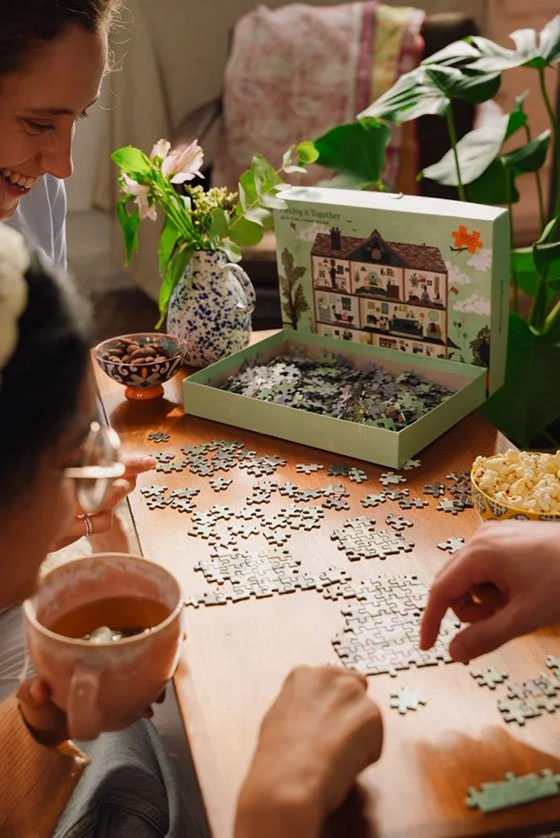
We are delighted that our ‘Piecing it Together’ puzzle is now here, and has had a fantastic response. We scattered the pieces over a meeting room table, and over the course of a week, members of our team contributed to completing it at different points. Adding a few pieces here and there, there was something quietly special about watching it all come together piece by piece.
In recent years, research has begun to catch up with what many people already sense intuitively: that sitting down with a puzzle offers something genuinely relaxing for the mind and body. This piece explores what the evidence tells us about puzzling as self-care, and why it may be particularly valuable for those navigating grief and loss.
What happens in the brain when we puzzle
Solving a jigsaw puzzle engages several different areas of the brain at once. A 2018 study published in Frontiers in Aging Neuroscience found that working with jigsaw puzzles engage several different thinking skills, including memory, problem-solving and visual awareness, making them one of the more mentally stimulating leisure activities available to us.
Puzzling also triggers the release of dopamine, a chemical in the brain linked to feelings of reward, motivation and pleasure. Each piece that fits into place produces a small but real sense of satisfaction, which can gently lift mood and sustain motivation during periods when both feel depleted.
Flow, focus and a quieter mind
One of the most well documented benefits of puzzling is its capacity to induce a state of flow, a term coined by psychologist Mihaly Csikszentmihalyi to describe the experience of being fully absorbed in an activity.
In a state of flow, time feels different, and the constant background noise of worry and racing thoughts begin to quieten. For people carrying grief, this kind of absorption offers genuine relief. It is not about avoiding feelings, instead, it is about giving the mind a place to rest, which is itself a necessary part of processing loss.
Stress reduction and the nervous system
Focused, repetitive tasks such as puzzling can help the body relax by supporting the nervous system's natural rest and recovery response. This can help reduce cortisol levels, slow the heart rate and ease the physical experience of stress and anxiety.
For those bereaved by suicide, whose nervous systems are often operating in a heightened state of alert, this gentle shift towards calm can be particularly valuable when other forms of self-care feel more difficult or demanding.
Mental wellbeing: emerging evidence
A recent pilot study from the University of Roehampton examined the effects of online jigsaw puzzling on mental wellbeing in older adults, finding meaningful improvements in self-reported wellbeing following regular puzzling.
While research specifically on puzzling and grief remains limited, the broader evidence on mentally engaging leisure activities and emotional regulation is encouraging. Jigsaw puzzles can be a part of a brain-healthy lifestyle, with a combination of mental stimulation, opportunities for connection and moments of relaxation, three factors consistently linked to improved mental health outcomes.
Puzzling as a gentle anchor
Grief can be disorienting. Having a puzzle in progress offers a gentle anchor, somewhere to return to, a small and manageable task within a world that may feel unmanageable.
Research on the Dual Process Model of grief suggests that wellbeing is supported not by constant immersion in loss, but by moving between attending to grief and engaging with the activities of daily life. A puzzle can be exactly that - a soft place to land in between.
Connection through puzzling
Puzzling does not have to be solitary. Working alongside another person on a shared puzzle creates a space for companionship without the pressure of sustained eye contact or conversation.
Many people find that side-by-side activity, hands occupied, attention gently shared opens space for the kind of quiet connection that grief often needs.
A note on self-compassion
Self-care is not about productivity or getting better quickly. It is about offering yourself the same gentleness you would offer someone you love. Sitting with a puzzle for twenty minutes, even if no section is completed, is still time spent in your own company, and that counts.
A meaningful gift that gives back
Our ‘Piecing it Together’ 1000-piece self-care jigsaw puzzle is available to purchase here. Pick it up as a treat for yourself, or as a meaningful gift for someone else. Every puzzle sold directly supports our core services and enables us to continue supporting people bereaved by suicide.