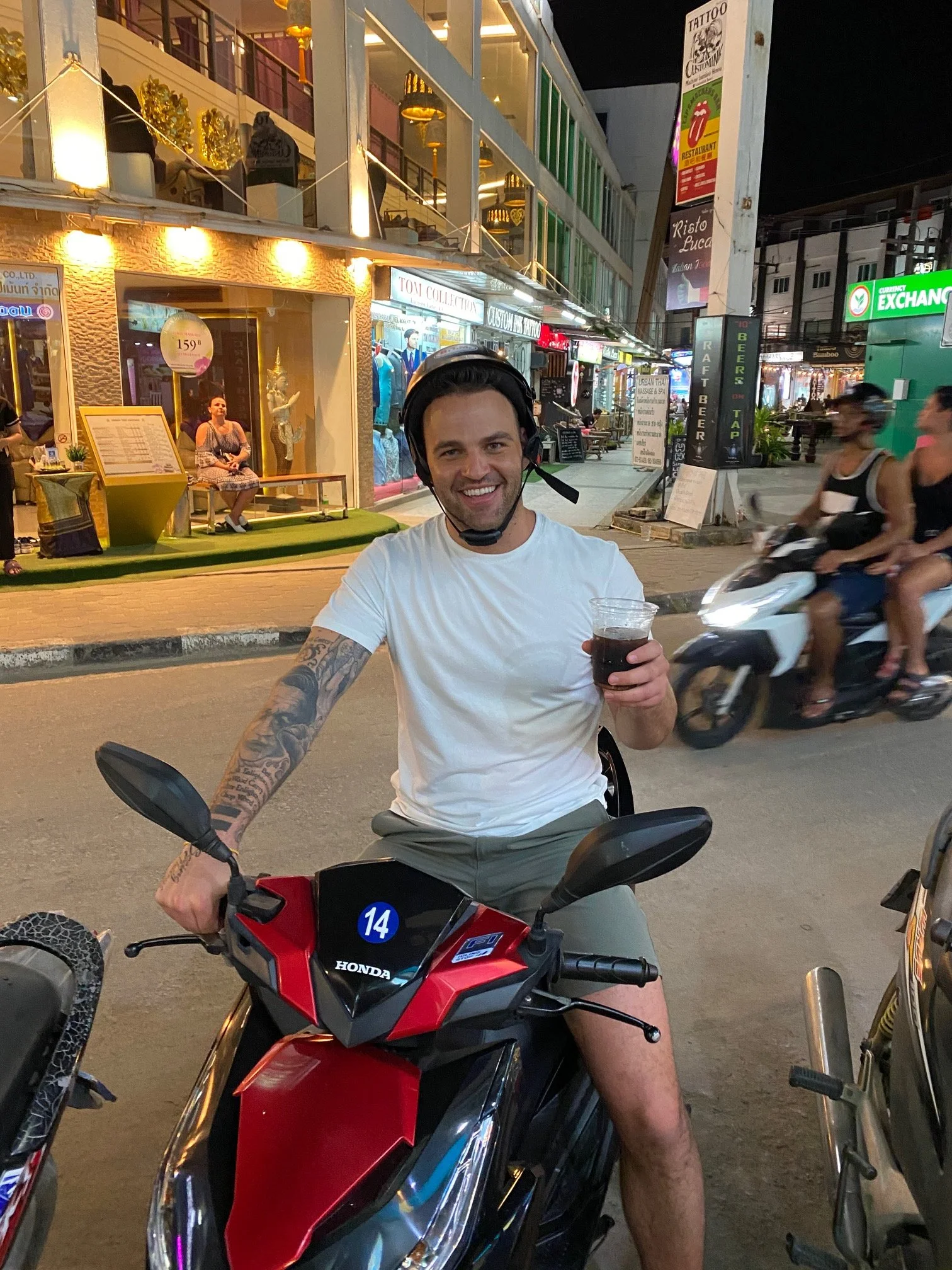
This is my way of saluting a huge-hearted diamond of a friend
David is one of Suicide&Co’s new Community Ambassadors. He tells the story that led him to become involved in suicide prevention and post-vention awareness, education and understanding.
It’s one of those messages I shall never forget. It was May 2021; the UK was coming out of a second lockdown, and I was in Wales to collect a puppy. My phone vibrated on the hotel nightstand. I turned it over to see a message from a friend asking, “Have you heard about Derek?” I hadn’t. But something in me knew.
The first time I met my friend I remember masquerading a sigh as my internal voice muttered “What an arrogant jerk!”. We were at a boxing gym in Thailand and before class one sweltering afternoon he swaggered his way over. Shirtless in 90-degree heat, he was more than six feet with chiselled good looks, broad shoulders, a six-pack and looked as though he’d just popped across from a Men’s Health cover shoot. He walked over from chatting to the most attractive woman in the gym (of course) and said: “Hi, I’m Derek. Nice to meet you. Where you from?”
Along with mutual friends, we smile now because everything about this guy we should have disliked. His looks, his confidence, his effortless popularity. Most of the women probably wanted to date him. All the men certainly wanted to go grab a beer with the coolest dude in the gym.
Well, as the saying goes - and it’s a lesson to which we should all heed (and on a daily basis) -“Never judge a book by its cover”.
The person I met that day turned out to be one of the most naturally empathetic and intuitive people with whom I’ve ever crossed paths. It’s not an especially fashionable trait in these times but he exuded kindness – and did so by the bucket load.
We became friends instantly. It was a friendship conducted across thousands of miles and on the occasions we’d meet up again in Thailand - but it was honest, deep, meaningful and we helped each other through some tough moments. I always remember smiling when I’d wake-up in the morning and – due to the time difference – see a waiting message from him illuminated on my phone.
When my Dad died, Derek was in regular contact, checking in on me and doing that rare thing we all need to do way more often when we ask someone “How are you?”. I’d say “Yes, I’m fine thanks.” And I’d get back: “No dude! It’s me. How are you? Really?”. I didn’t know at the time quite the extent of the turmoil and torment he was going through which, with hindsight, made his inherent empathy even more remarkable.
Sadly, our friendship wasn’t destined to span the decades for, in May 2021, my buddy took his own life. He was 35. I know that had he not, our friendship had every indication of being life-long. He was a senior firefighter in Calgary and his death was recorded as being from “work related illness”, something I know brings his family some comfort as his PTSD had been both extensive and one for which he had – in typical Derek style - declined help whilst, at the same time, always looking out for everyone else.
In the realms of loss, suicide is one of the most acute and visceral things those of us left must deal with on this journey we call “life”. Someone said to me that it “blindsides” you and “it just keeps on blindsiding you”.
Five years have now passed and so often it’s the little things, the small reminders that dwarf the larger picture, the wider expanse of loss. It’s the chat about stuff and nonsense. It’s the banter; the guy talk. It’s the “Hey man, what do you reckon I should do about..?” And it’s the deeper conversations about life, relationships and family. Yes, men do have those exchanges but clearly nowhere near as often as we should.
A few years back, I heard UFC fighter Paddy Pimblett recount the loss of his friend Ricky. He said: “I’d rather have a mate crying on my shoulder than be going to his funeral next week.”
I know I’d pay a princely sum now for one more chat with my friend. Through volunteering I now know more about bereavement by suicide and its turbulent aftermath but I have, as I learn, come to understand that – in so many instances – those who decide they no longer wish to be a part of this world possess a certain “quality”.
I’d watch my friend on numerous occasions and marvel at his ability to make whomever he was talking to feel, not just at ease, but like they were the most important person in that gym, bar or restaurant. And he did it with such natural charm, such honesty and by being so open and non-judgemental to whatever he got back.
When asked “Does it get better?” The legendary comedienne Joan Rivers [whose husband Edgar died by suicide] replied: “No, it doesn’t get better, but I get better at it.” And there is something in that. But, with suicide, grief is intertwined with all those regrets: those what ifs?, those “I wish I could have spoken to him/her on that day”. And then there are all those unanswered questions. But, as a counsellor said to me, “The reason it (suicide) is so hard is because we don’t know. We just don’t know. And we’ll never know.”
My friend and I had shared passions for travel and for Muay Thai (Thai boxing) and it is in these, for me, the most painful of memories are stirred.
I want to message him when I visit some new destination, or when I return to his (and my) “happy place” in Thailand. Or when I’ve had an especially good or - more likely for me - bad session “on the pads”. It those moments that catch you unaware.
On a snowy Thanksgiving Sunday last October in Calgary – on what would have been Derek’s 40 th birthday – I got to visit his grave and spend the day with his wonderful parents, Andy and Donna, and his sister Arian and her lovely family. It was tough and emotional but it was also an incredibly beautiful day. And it was a time that truly helped me understand more than I’d ever understood about the most appropriate ways we can all support those left to deal with this most cruel and complex form of loss. It’s about the language we use. It’s about not being afraid to upset someone [you won’t]. And, as Andy said to me in a moment we were alone and he was gifting me some of his son’s belongings such as his Calgary Firefighter’s baseball cap complete with his badge number: “One of the most important things for us is for people to keep remembering him; to keep saying his name.”
Amidst the terrible sadness that never diminishes, there are also moments that make me smile and make me feel that, no matter how fleetingly, I am honoured I met that swaggering, gentle giant that day in Thailand. And I’m proud that, albeit briefly, I got to call Derek Sharman “my friend”.
A version of this article first appeared in Inspire the Mind – a digital magazine from King’s College London at the intersection of mental health research, lived experience and society. It does this with the help of writers with lived experience and academics who have dedicated their lives to this research.